Left-Handed Golf Grip: The Complete Guide to Proper Hand Placement
Your grip is the only connection between your body and the golf club. Every ounce of power, every degree of clubface angle, and every bit of feel passes through your hands. If the grip is wrong, nothing else in your swing can compensate for it. For left-handed golfers, this reality is compounded by a frustrating truth: nearly all grip instruction is written for right-handed players, and the advice to simply reverse it is dangerously incomplete.
Left-handed golfers face unique biomechanical considerations. Your dominant hand, your trail hand, and your lead hand all play different roles than what conventional instruction assumes. The muscle memory you have developed from a lifetime of left-handed daily tasks directly influences how your hands interact with the club. Understanding these differences is the first step toward building a grip that generates power, maintains control, and holds up under pressure.
This guide is written natively for left-handed golfers. There is no right-handed instruction to decode or mentally flip. Every step, every finger placement, and every pressure point described below is exactly as it applies to you.
Watch: Left-Handed Grip Basics
See the proper left-handed grip demonstrated step-by-step:
Understanding Hand Roles for Left-Handed Golfers
Before placing a single finger on the club, you need to understand the fundamental roles each hand plays in the left-handed golf swing. This is where most lefty golfers get confused, because casual advice from right-handed playing partners uses terminology that maps incorrectly to your setup.
For left-handed golfers:
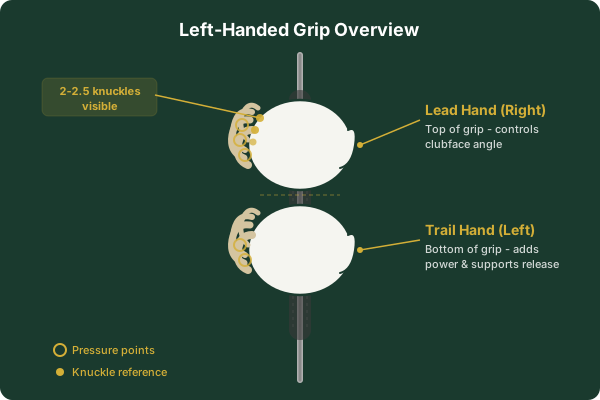
- Your RIGHT hand is the lead hand (top hand). It sits at the top of the grip, closest to the butt end of the club. The lead hand controls the clubface angle, sets the wrist hinge, and serves as the primary stabilizing force throughout the swing. Think of it as the steering wheel.
- Your LEFT hand is the trail hand (bottom hand). It sits below the right hand on the grip, closer to the clubhead. The trail hand adds power, supports the release through impact, and fine-tunes the clubface at the moment of contact. Think of it as the accelerator.
This distinction matters enormously. Many left-handed golfers unknowingly let their left hand dominate the grip because it is their dominant hand and it feels natural to take control. But in the golf swing, the lead hand (right hand) must be the authority. Your dominant left hand needs to learn a supporting role, which is counterintuitive but essential.
The Three Grip Styles for Left-Handed Golfers
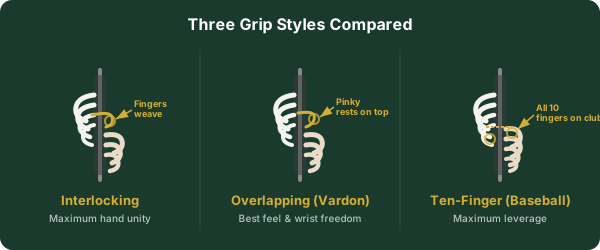
There are three established ways to connect your hands on the golf club. Each has specific advantages depending on your hand size, finger length, strength, and personal comfort. No single style is universally superior. The best grip is the one that lets you control the clubface while generating speed without tension.
1. The Interlocking Grip
The interlocking grip physically locks your hands together by weaving the fingers of each hand. This creates a unified feel and prevents the hands from working independently during the swing. It is the most popular grip among professional golfers and is particularly well-suited for players with smaller hands or shorter fingers.
When to use it: If you have average or smaller hands, if you want maximum hand unity, or if you struggle with the club shifting during your swing. This is also an excellent starting grip for beginners because it teaches the hands to work as a single unit from day one.
Step-by-step for left-handed golfers:
- Place your right hand (lead hand) on the grip first. The handle should run diagonally from the base of your index finger across the pad below your pinky finger. Wrap your fingers around the grip.
- Position your right thumb slightly to the left of center on the top of the grip. It should not sit directly on top.
- Bring your left hand (trail hand) to the grip. Before wrapping it, interlock the pinky finger of your left hand between the index and middle fingers of your right hand.
- Wrap the remaining fingers of your left hand around the grip. Your left thumb should rest on the right side of the shaft, fitting snugly into the lifeline of your right palm.
- Both thumbs should point generally down the shaft, forming a slight angle. Neither thumb should wrap around the grip.
2. The Overlapping (Vardon) Grip
Named after Harry Vardon, this grip places the pinky finger of the trail hand on top of the gap between the index and middle fingers of the lead hand, rather than interlocking between them. It offers a slightly softer connection between the hands, which many golfers find allows for better feel and wrist freedom.
When to use it: If you have larger hands, longer fingers, or if the interlocking grip feels cramped. Also preferred by players who want more wrist action in their swing, particularly for shot-shaping and short-game feel. Many experienced golfers gravitate toward this style as their technique matures.
Step-by-step for left-handed golfers:
- Place your right hand (lead hand) on the grip using the same diagonal positioning described above. Wrap your fingers and position your right thumb slightly left of center.
- Bring your left hand (trail hand) to the grip. Rest the pinky finger of your left hand on top of the ridge between the index and middle fingers of your right hand.
- The pinky should sit comfortably in the groove, not perched awkwardly on top of a knuckle. If it feels unstable, adjust your right-hand finger spacing slightly.
- Wrap the remaining left-hand fingers around the grip, with your left thumb resting on the right side of the shaft.
- Check that both hands feel connected but not tense. The overlapping grip should feel slightly more relaxed than the interlocking version.
3. The Ten-Finger (Baseball) Grip
The ten-finger grip places all ten fingers directly on the club with no interlocking or overlapping. The hands sit side by side on the grip. Despite sometimes being dismissed as a beginner grip, it has legitimate applications and is used by several touring professionals.
When to use it: If you have arthritis or joint pain that makes interlocking uncomfortable, if you have very small hands, if you are a complete beginner building initial comfort with the club, or if you struggle to generate clubhead speed. The ten-finger grip maximizes leverage and can add distance for players who need it.
Step-by-step for left-handed golfers:
- Place your right hand (lead hand) on the grip in the standard diagonal position. Wrap all four fingers around the grip with your thumb slightly left of center.
- Place your left hand (trail hand) directly below the right hand. All four fingers wrap around the grip, with the pinky sitting snugly against the index finger of your right hand.
- Your left thumb rests on the right side of the shaft, same as with other grip styles.
- Ensure there is no gap between your hands. The right pinky and left index finger should be touching, creating a seamless connection along the grip.
- Check that both hands feel equally engaged. The risk with this grip is that the hands can work independently, so focus on keeping them pressed together as a unit.
Lead Hand (Right Hand) Placement in Detail
Your right hand is the foundation of the entire grip. Every element of consistency starts here, and getting it wrong will cascade through the rest of your setup and swing. Take the time to get this right before even thinking about your left hand.
The Grip Line: The club should rest along a diagonal line running from the middle of your right index finger to the base pad just below your pinky. This is critical. If the club sits too much in the palm, you lose wrist mobility and feel. If it sits too far in the fingers, you lose stability and control. The diagonal ensures the right balance.
Finger Wrap: Close your fingers around the grip, starting with the last three fingers (pinky, ring, middle). These fingers provide the primary hold. Your index finger should wrap in a slightly triggered position, as though resting on a trigger. There should be a visible gap between your index finger and middle finger. This trigger position gives you fine motor control over the clubhead.
The Right Thumb: Place your right thumb just to the left of the top-center of the grip. It should not sit directly on top of the shaft. The pad of your thumb presses gently against the grip, not squeezing. A common error is extending the thumb too far down the shaft. Keep it compact.
The V-Line: When your right hand is correctly placed, the crease between your thumb and index finger forms a V shape. For a left-handed golfer with a neutral grip, this V should point roughly toward your left ear or left shoulder. If the V points at your chin, your grip is too weak. If it points well past your left shoulder, your grip is too strong. This V-line is one of the best self-diagnostic tools you have.
Pressure Distribution: The last three fingers of your right hand do the majority of the holding work, accounting for roughly 60% of the total grip pressure in the lead hand. The thumb and index finger provide guidance and feel, contributing the remaining 40%. Never death-grip the club with your thumb and forefinger. That kills feel instantly.
Trail Hand (Left Hand) Placement in Detail
Your left hand joins the grip after the right hand is set. Its primary purpose is to add power and support the clubface through impact. Because this is your dominant hand, the temptation is to grip too tightly or to position it in a way that takes over control. Resist this urge.
How It Connects: Regardless of which grip style you have chosen (interlocking, overlapping, or ten-finger), the left hand approaches from the same angle. The grip should rest in the fingers, not the palm. Specifically, the club sits along the base of your left fingers, just above where the fingers meet the palm. This finger-based hold is essential for generating speed through wrist release at impact.
The Left Thumb: Your left thumb sits on the right side of the grip, nestled into the lifeline of your right hand. It should feel like the left thumb is covered and protected by the right palm. If you can see your left thumb when you look down at your grip, your right hand has come off position.
The Left-Hand V-Line: Just like the right hand, your left hand also forms a V between the thumb and index finger. For a neutral grip, this V should point in the same direction as the right-hand V, roughly toward your left ear or left shoulder. When both V-lines are parallel and pointing in the same direction, your hands are unified and the clubface will return to square more consistently.
Common Trail Hand Errors:
- Gripping too tightly: As your dominant hand, the left hand naturally wants to squeeze. This creates tension in your forearm, restricts wrist hinge, and reduces clubhead speed. Consciously soften your left-hand pressure.
- Rolling the hand under the grip: Some lefties rotate their left hand too far under the shaft, creating an excessively strong grip position. This closes the clubface and promotes hooks.
- Separating from the right hand: If the connection between hands feels loose, especially at the top of the backswing, your trail hand is drifting. Re-check your interlocking, overlapping, or side-by-side connection.
- Palm grip instead of finger grip: Placing the club deep in the left palm robs you of the wrist speed that generates distance. Keep it in the fingers.
Grip Pressure: The 1-10 Scale for Left-Handed Golfers
Grip pressure is the invisible variable that separates good ball strikers from great ones. Too tight and you lose speed, feel, and fluidity. Too loose and the club twists at impact, costing you accuracy. Finding the right pressure is an ongoing calibration, not a one-time setting.
Use a scale of 1 to 10, where 1 is barely holding the club and 10 is squeezing as hard as you physically can.
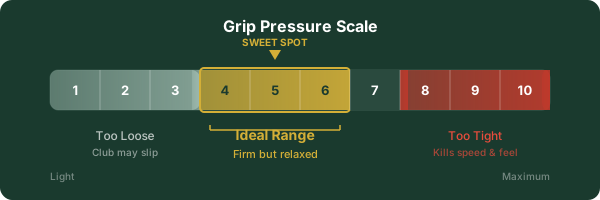
- Lead hand (right hand) overall pressure: 5 out of 10. Firm enough that the club will not slip, light enough that your forearm muscles stay relaxed.
- Last three fingers of the right hand: 6 out of 10. These are your anchor points and carry slightly more responsibility.
- Right thumb and index finger: 3 out of 10. Light touch for feel and feedback. These fingers sense the clubhead.
- Trail hand (left hand) overall pressure: 4 out of 10. Noticeably lighter than the lead hand. This prevents your dominant hand from taking over.
- Left-hand fingers: 4 out of 10. Consistent, soft, even pressure across all fingers.
The Pressure Check: At address, hold the club in your finished grip and have a friend try to gently twist the club. It should resist twisting without your knuckles turning white. If they can easily rotate the club, you are too light. If your forearms are visibly tense, you are too tight.
Common Left-Handed Grip Mistakes
Knowing what to avoid is just as valuable as knowing what to do. These are the grip errors seen most frequently among left-handed golfers, along with the ball-flight symptoms they produce.
Weak Grip Causing a Slice
A weak grip occurs when both hands are rotated too far to the right on the club (for a lefty). The V-lines point at your chin or even to the right of it. This leaves the clubface open at impact, producing a slice that starts left and curves hard to the right. If you consistently battle a left-to-right ball flight, check your V-lines first. Rotating both hands slightly to the left (strengthening the grip) is often the fastest fix in golf.
Strong Grip Causing a Hook
The opposite problem. Both hands are rotated too far to the left, with V-lines pointing well past your left shoulder. This closes the clubface aggressively at impact, producing a hook that starts right and curves sharply left. Hooks are harder to control than slices because they carry more topspin and run further offline. If you are hitting snap hooks, weaken your grip by rotating both hands slightly back to the right until the V-lines point at your left ear.
Grip Too Much in the Palm
When the club sits deep in the palms of either hand rather than along the fingers, you lose wrist hinge capability. The result is a stiff, armsy swing that lacks power and produces a low, weak ball flight. This is especially common in the trail hand (left hand) for lefties because your dominant hand instinctively wants to grab and control. Move the club into the fingers and you will immediately feel more freedom and whip in your swing.
Wrong Hand Dominance Assumptions
Some left-handed golfers were taught to play right-handed as children because left-handed equipment was harder to find. Others play left-handed despite being naturally right-handed because it felt more athletic. In either case, the typical hand dominance assumptions may not apply to you. If standard grip advice consistently fails to produce results, consider whether your hand dominance in golf matches your hand dominance in daily life. A qualified club fitter can help assess this. For a deeper dive on equipment considerations, read our Ultimate Club Fitting Guide for Lefties.
How to Check Your Grip at Home
You do not need a coach watching over your shoulder to verify your grip. These self-diagnosis methods can be done in your living room with a club or even a broomstick.
- The V-Line Test: Grip the club and look down. Both V-lines (formed by thumb and index finger) should point toward your left ear or left shoulder. If they point in different directions, your hands are fighting each other.
- The Knuckle Count: With your grip set and arms hanging naturally, count how many knuckles you can see on your right hand (lead hand). For a neutral grip, you should see two to two and a half knuckles. One knuckle visible means your grip is too weak. Three or more means it is too strong.
- The Hinge Test: Grip the club and try to hinge your wrists upward (cocking the club toward the sky). If you can achieve a full 90-degree wrist hinge without the club feeling like it is slipping, the club is correctly positioned in your fingers. If the hinge feels restricted, the club is too deep in your palms.
- The Release Test: Take your grip and swing to the top of your backswing position. Now remove your left hand entirely. Can your right hand (lead hand) hold the club securely at the top without the club dropping or rotating? If so, your lead hand grip is solid. If the club feels unstable, re-check your lead hand pressure points.
- The Waggle Test: Grip the club and waggle it back and forth with your wrists. The club should feel like an extension of your arms, not a separate object you are holding. If it feels disconnected, try adjusting your finger pressure until the club feels integrated with your hands.
Grip Adjustments for Different Clubs
Your grip should not be identical for every club in the bag. Subtle adjustments based on the club you are holding will improve both your consistency and your scoring.
Driver
With the driver, you want maximum clubhead speed and a slightly ascending angle of attack. Lighten your overall grip pressure by one point on the 1-10 scale compared to your irons. This frees your wrists to fully release through the hitting zone. Some lefties also benefit from strengthening the grip slightly (rotating both hands a degree to the left) with the driver to promote a draw and reduce the slice that plagues many players off the tee.
Irons
Your standard grip. Neutral V-lines, moderate pressure (5 out of 10 on the lead hand), club seated in the fingers. Irons demand precision more than raw speed, so focus on maintaining consistent pressure throughout the swing rather than maximizing freedom. The grip fundamentals described earlier in this guide are calibrated for iron play. For more on how grip affects your iron swing, see our 5 Swing Fundamentals Every Lefty Must Master.
Putter
Putting grips deserve their own category because the priorities are entirely different. Speed is irrelevant. Wrist action is generally unwanted. Feel and stability are everything. Many left-handed golfers benefit from a reverse overlap putting grip, where the index finger of the right hand (lead hand) extends down and overlaps the fingers of the left hand (trail hand). This locks the wrists and encourages a shoulders-driven stroke. Grip pressure for putting should be very light, around 3 out of 10, in both hands equally. Some lefties also experiment with cross-handed (left hand on top) putting grips, which can reduce wrist breakdown on short putts.
Famous Lefty Grips: What Mickelson and Watson Do Differently
Studying how the best left-handed golfers in history grip the club reveals that there is room for personal variation within the fundamentals.
Phil Mickelson uses a variation of the overlapping grip but with notably soft hands. His grip pressure is famously light, which is a key reason for his exceptional short-game feel and his ability to hit creative shots around the green. His grip also tends toward the strong side, with both V-lines pointing past his left shoulder. This promotes the right-to-left ball flight he uses to navigate courses strategically. What sets him apart is how he adjusts his trail hand pressure shot by shot, softening it for finesse shots and firming it for power drives. His hands are constantly adapting rather than locked into a single setting.
Bubba Watson takes a different approach. Watson uses an interlocking grip with notably firm lead-hand pressure. His right hand (lead hand) anchors the club aggressively while his left hand (trail hand) stays relatively passive until the release point, where it fires through impact with explosive speed. This asymmetric pressure distribution is part of what generates his extraordinary distance. Watson also plays with a grip that is slightly weaker than Mickelson's, which allows him to shape the ball in both directions. His ability to hit massive cuts and draws on demand comes partly from this more neutral grip position that gives him room to manipulate the clubface.
The lesson from both players: master the fundamentals first, then experiment with pressure, strength, and style to match your natural tendencies. There is no single perfect grip. There is only the grip that works for your swing, your body, and your game.
Building Your Left-Handed Grip: A Practice Plan
Changing your grip is one of the most uncomfortable things you can do in golf. A new grip will feel wrong for days or even weeks before it starts to feel natural. That discomfort is normal and expected. Do not abandon a fundamentally correct grip because it feels awkward at first.
Week 1: Spend ten minutes per day gripping and re-gripping the club at home without hitting balls. Focus on lead hand placement, the V-line, and finger positioning. Do this while watching television. Repetition builds muscle memory faster than conscious practice on the range.
Week 2: Take your new grip to the range but hit only half shots with a 7-iron. Pay zero attention to where the ball goes. Focus entirely on maintaining grip pressure and hand position through the swing. Hit 50 half shots per session.
Week 3: Progress to full swings but keep it to one club (7-iron or 8-iron). Start paying attention to ball flight. The pattern you see will tell you whether your grip is neutral, weak, or strong. Adjust accordingly.
Week 4 and beyond: Introduce additional clubs one at a time, starting with wedges and working up to the driver. Play at least one casual round with the new grip before taking it into any competitive setting.
Conclusion: Your Grip Is Your Foundation
Everything in your golf swing flows from the grip. A solid left-handed grip built on the correct hand roles, proper finger positioning, appropriate pressure, and a grip style that matches your hands will improve every aspect of your game. It affects your clubface angle at impact, your wrist hinge and release, your ability to shape shots, and your consistency under pressure.
Do not rush this process. A grip change is a commitment measured in weeks, not minutes. But the payoff is permanent. Once you build a fundamentally sound left-handed grip, it will serve you for the rest of your golf career.
Revisit this guide periodically. Grips can drift over time without you noticing. Use the home check methods described above at least once a month to confirm your V-lines, knuckle count, and pressure are still where they should be.
Want more lefty-specific instruction? Join our community to get personalized feedback from experienced left-handed golfers and instructors who understand your game.