Left-Handed Golf Setup and Alignment: A Complete Visual Guide
Introduction: Why Alignment Is the #1 Source of Confusion for Lefties
If you're a left-handed golfer, you already know the frustration. You search for a setup tutorial on YouTube and every single one shows the right-handed perspective. You buy a golf instruction book and every diagram, every overhead view, and every drill description is drawn for a right-handed player. You take a group lesson and the instructor demonstrates everything from the right side, telling you to "just mirror it."
The problem is that "just mirroring it" introduces confusion at the most critical moment of your golf swing: the address position. Alignment errors at setup compound exponentially through the swing. A two-degree misalignment at address can send your ball twenty yards offline at 200 yards. And when you're mentally translating right-handed instructions into a left-handed setup, those errors creep in constantly.
This guide is different. Every word, every direction, and every reference point is written natively from the left-handed perspective. There is nothing to mirror or translate. This is your setup guide, built from the ground up for how you stand over the ball.
The Left-Handed Address Position
The address position is the foundation of every golf shot. For left-handed golfers, this means standing on the right side of the ball (from your perspective facing the target) with the club extending to your left. Let's break down every element of a proper lefty address position.
Feet Positioning
Your right foot is your lead foot as a left-handed golfer. It sits closer to the target. Your left foot is your trail foot, positioned further from the target. At address, your right foot should be flared slightly toward the target (opened about 20 to 30 degrees). This allows your hips to clear efficiently through impact. Your left foot can be square to the target line or flared slightly away from the target to facilitate a full backswing turn.
A common mistake lefties make is positioning both feet square to the target line. This restricts hip rotation in both directions and leads to compensations that destroy consistency. Flare that right foot open and give your body room to rotate through the ball.
Shoulder Alignment
Your shoulders should run parallel to your target line. For a lefty, this means your right shoulder is closer to the target and your left shoulder is further away. At address, your right shoulder will naturally sit slightly lower than your left because your right hand is lower on the grip. This is correct and desirable. Do not try to level your shoulders artificially.
The key checkpoint: if you held a club across both shoulders and let it drop, it should point parallel to your target line, not at the target itself. This is one of the most misunderstood concepts in golf alignment, and we will cover it in detail in the railroad tracks section below.
Hip Alignment
Your hips should mirror your shoulder alignment, running parallel to the target line. Many left-handed golfers unconsciously open their hips at address (rotating them toward the target) because years of right-handed instruction have conditioned them to face the target more directly. Resist this. Square hips at address allow you to make a complete backswing turn and generate maximum power through the downswing.
A useful checkpoint: place a club across both hip bones at address. It should point parallel to the target line, matching your shoulder line and foot line.
Eye Line
Your eyes should be positioned directly over or just inside the ball at address. For lefties, this means your head is positioned slightly to the right of the ball (toward the target). This gives you a clear view of the target line and helps you see the correct swing path.
If your eyes are too far outside the ball (to the left, away from target), you will tend to aim too far to the right. If your eyes are too far inside (to the right, toward target), you will tend to pull your alignment left. Getting your eye line correct eliminates one of the most subtle alignment errors in the game.
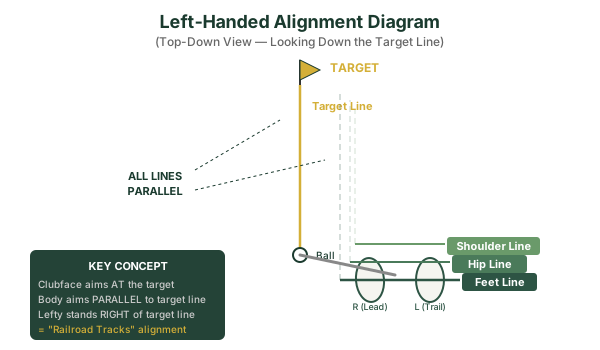
The "Railroad Tracks" Concept for Lefties
The railroad tracks analogy is the most effective way to understand golf alignment, but it is almost always taught from the right-handed perspective. Here is how it works for you as a left-handed golfer.
Target Line vs. Body Line
Imagine two parallel lines on the ground, like railroad tracks. The outer rail (the one further from you) runs from your ball directly to the target. This is your target line. The inner rail (the one closer to you, running through your toes) is your body line. These two lines are parallel. They never converge.
This is the critical concept that trips up so many golfers, left-handed and right-handed alike: your body does NOT aim at the target. Your body aims parallel left of the target (from the lefty perspective, this means your feet, hips, and shoulders all point to the right of where you want the ball to go). Only the clubface aims at the target.
Think about it this way: if your target is a flagstick 150 yards away, your feet line points to a spot roughly 5 to 10 feet to the right of the flag. That is how parallel lines work at distance. They appear to converge but they remain parallel.
How to Use Alignment Sticks as a Lefty
Alignment sticks are the single best training aid you can buy, and they cost almost nothing. Here is how to set them up from the left-handed perspective:
- Place the first stick on the ground running from behind the ball toward the target. This marks your target line. As a lefty, you are standing on the right side of this stick.
- Place the second stick parallel to the first, about 18 inches closer to you (to the right of the target line stick). This marks your toe line and represents your body alignment.
- Stand with your toes along the inner stick and the ball positioned next to the outer stick. Your feet, hips, and shoulders should all run parallel to both sticks.
The reason this must be described from the lefty perspective is that the spatial relationship is reversed. You are standing to the right of the target line, not to the left of it. If you set up alignment sticks using a right-handed guide and simply stand on the other side, you often end up with the sticks angled incorrectly because the reference points change.
Ball Position for Every Club as a Lefty
Ball position has an enormous impact on launch angle, spin rate, and contact quality. As a left-handed golfer, your reference point is your right foot (lead foot, closest to target) and your left foot (trail foot, furthest from target). Here is where to position the ball for each club category.
Driver
Position the ball just inside your right heel. This is roughly one to two inches from the inside of your right foot, toward center. This forward ball position allows you to catch the ball on the upswing, maximizing launch angle and reducing spin for maximum distance. Your hands should be roughly even with the ball or slightly behind it.
Fairway Woods and Hybrids
Move the ball one ball-width inside your right heel, or approximately one inch further back toward center compared to your driver position. Fairway woods and hybrids require a slightly more descending blow than the driver, but you still want to sweep the ball off the turf rather than taking a deep divot.
Long Irons (3-iron through 5-iron)
Position the ball center-right in your stance. This means it sits between the center of your stance and your right foot, roughly two inches right of center. Long irons need a descending strike, and this ball position promotes ball-first contact with a shallow divot after the ball.
Mid Irons (6-iron through 8-iron)
The ball should be positioned at the center of your stance, equidistant between your right and left feet. This is the neutral position that promotes a clean, descending strike with a consistent divot pattern. Mid irons are your baseline reference point. When in doubt with any club, start at center and adjust from there.
Short Irons and Wedges (9-iron, PW, GW, SW, LW)
Position the ball center-left in your stance, roughly one to two inches left of center (toward your trail foot). This promotes a steeper angle of attack, which is exactly what you want for scoring clubs. A steeper strike generates more spin, more control, and more consistent distance gapping.
- Driver: Inside right heel (lead foot)
- Fairway woods/hybrids: 1 ball inside right heel
- Long irons: Center-right
- Mid irons: Center
- Short irons/wedges: Center-left (toward trail foot)
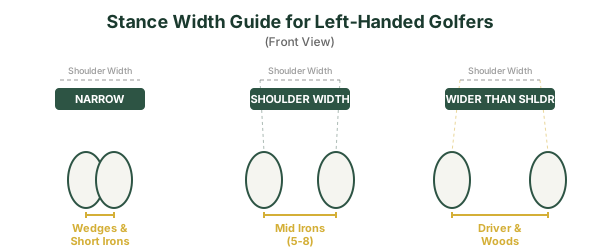
Stance Width Guide by Club
Your stance width directly affects your balance, power, and swing arc. As a general rule, wider stances create more stability and power but reduce mobility. Narrower stances increase mobility and control but sacrifice some power. Here is the guide for left-handed golfers.
- Driver: Inside of both feet roughly shoulder-width apart, or slightly wider. You need a stable base for the longest, fastest swing in your bag.
- Fairway woods and hybrids: Slightly narrower than driver width. The inside of your feet should be just inside shoulder width.
- Long irons: Shoulder-width apart. You want stability but enough mobility to make a full turn.
- Mid irons: Just inside shoulder width. This promotes a controlled, repeatable swing.
- Short irons: Narrower than shoulder width by two to three inches per foot. Precision matters more than power with these clubs.
- Wedges (pitch shots and chips): Narrow stance, feet six to eight inches apart. Maximum control and feel.
- Putting: Shoulder-width or slightly wider. Stability is everything on the greens.
A common lefty mistake is using the same stance width for every club. This forces compensations in your swing that lead to inconsistency. Take 30 seconds at address to check your stance width before each shot until it becomes automatic.
Posture and Spine Tilt for Lefties
Proper posture at address is the framework that allows everything else to function. Poor posture leads to compensations throughout the swing, and compensations lead to inconsistency. Here is how to build a solid lefty posture from the ground up.
How Right-Hand-Low Creates Natural Spine Tilt
As a left-handed golfer, your right hand sits lower on the grip than your left hand. This naturally tilts your spine slightly away from the target (tilting to the left, away from the target). This spine tilt is correct and important. It positions your head behind the ball and creates the proper angle for an ascending strike with the driver and a shallow, sweeping strike with fairway clubs.
The amount of spine tilt should be subtle, roughly 5 to 10 degrees away from the target. Do not exaggerate it. Too much tilt causes your weight to fall onto your left foot at address, making it difficult to shift properly during the swing. Let the natural hand position on the grip dictate the tilt.
Knee Flex
Your knees should be slightly flexed at address, as if you were about to sit on a tall barstool. The flex should feel athletic and ready, not deep or squatty. A good checkpoint: if you looked down, your kneecaps should be over the balls of your feet, not over your toes and not behind your heels.
Both knees should have equal flex. Some lefties develop a habit of flexing their right knee (lead knee) more than their left, which tilts the pelvis and throws off alignment. Keep it even.
Distance from the Ball
Stand tall, then bend from your hips (not your waist) until your arms hang naturally below your shoulders. The distance from the ball is determined by where the clubhead touches the ground when your arms are hanging freely. You should not be reaching for the ball or crowding it.
A reliable test: at address, you should be able to fit a fist between the butt end of the club and your left thigh (trail leg). If you cannot fit a fist, you are standing too close. If you can fit two fists, you are standing too far away.
Common Alignment Mistakes Left-Handed Golfers Make
After coaching hundreds of left-handed golfers, certain setup errors appear again and again. These mistakes are almost always caused by years of translating right-handed instruction. Here are the most common ones and how to fix them.
Aiming Too Far Right
This is the single most common alignment error among left-handed golfers. Because lefties stand on the right side of the ball, there is a natural tendency to let the shoulders and feet drift open (pointing to the right of the target). This creates a swing path that cuts across the ball from outside to inside, producing a fade or slice that starts right and curves further right.
The fix: use alignment sticks at every practice session and have a playing partner occasionally check your alignment on the course. Most lefties are shocked to discover how far right they are actually aiming. Building awareness is the first step, and alignment sticks make the problem visible immediately.
Shoulder Alignment vs. Foot Alignment Mismatch
Many lefties get their feet aligned correctly but let their shoulders open to the target. This is incredibly common and incredibly damaging. Your swing follows your shoulders, not your feet. If your feet are square but your shoulders are open, you will swing on an out-to-in path regardless of where your feet are pointing.
The fix: after setting your feet, lay a club across your shoulders and check that it points parallel to your target line. Do this for every shot during practice until your body learns the feeling of true parallel alignment between feet, hips, and shoulders.
Copying Right-Handed Setup Positions Without Mirroring
This is the most insidious error because lefties often do not realize they are doing it. When you watch a right-handed golfer set up and try to replicate the "look" of their address position, you can end up with ball position, weight distribution, and alignment that is subtly wrong in every dimension. The visual impression of a right-handed setup does not translate directly into how a left-handed setup feels.
The fix: stop watching right-handed setup demonstrations. Seek out left-handed instruction (like this guide), and when you do watch right-handed content, pause and deliberately translate every direction before incorporating it into your game. Better yet, film your own setup from multiple angles and analyze it against lefty-specific reference points.
The Pre-Shot Alignment Routine for Lefties
A consistent pre-shot routine eliminates guesswork and builds confidence. Here is a step-by-step routine designed specifically for left-handed golfers. Every tour professional has a pre-shot routine, and yours should be just as deliberate.
Step-by-Step Process
- Stand behind the ball. Position yourself directly behind the ball, looking at the target. As a lefty, you will approach the ball from the left side when you walk into your stance. From behind, pick your target and visualize the ball flight.
- Pick an intermediate target. Find a spot on the ground roughly 3 to 5 feet in front of your ball (between the ball and the target). This could be a divot, a discolored patch of grass, or a leaf. It is far easier to align to something 4 feet away than 150 yards away.
- Walk into your stance from the left side. Approach the ball and set the clubface first, aiming it at your intermediate target. Do not set your feet first. The clubface establishes the target line.
- Set your right foot (lead foot). Position it relative to the ball based on which club you are hitting (see ball position guide above).
- Set your left foot (trail foot). Establish your stance width based on the club you are hitting.
- Check your alignment. Glance at your intermediate target and the far target. Do your feet, hips, and shoulders all feel parallel to the target line? If something feels off, step back and restart from step one. Never hit a shot from a setup that feels wrong.
- Waggle and go. Take one or two waggles to stay loose, then execute the shot. Do not stand over the ball for more than 8 to 10 seconds after completing your setup. Paralysis leads to tension, and tension destroys golf swings.
Using Intermediate Targets
The intermediate target technique deserves special emphasis for left-handed golfers. Because we stand on the right side of the ball, our visual perspective of the target line is slightly different from a right-handed player. Using a close-range intermediate target eliminates the parallax effect that can throw off your aim.
Pick your intermediate target from behind the ball, where you can see the true line to the target. Once you walk into your stance, simply aim the clubface at that near-ground reference point. Trust the line you chose from behind. Do not second-guess it from address, where your perspective has shifted.
How to Practice Alignment at the Range
The driving range is where you build alignment habits. The course is where you trust them. Here is how to structure your range sessions to engrain proper left-handed alignment.
Every Session: The Alignment Stick Foundation
Before hitting any balls, set up two alignment sticks on the ground: one for your target line and one for your body line. Hit every shot during your session with these sticks in place. No exceptions. This is the most important habit you can develop as a left-handed golfer.
The Gate Drill
Place two tees in the ground roughly two inches wider than your clubhead, one inch in front of the ball on the target line. This creates a gate. If your clubhead passes through the gate, your swing path is on line. If you hit a tee, your path is off. This drill gives you instant feedback on whether your alignment is producing the correct swing path.
The Closed-Eyes Drill
Set up to a ball with your alignment sticks in place. Close your eyes, then shuffle your feet and rotate your body for 5 seconds. Now, without opening your eyes, try to return to your address position. Open your eyes and check your alignment against the sticks. This drill trains your body to find proper alignment by feel rather than sight.
The Walk-Away Test
Set up to a ball with perfect alignment (sticks in place, everything square). Step away. Walk around for 10 seconds. Then walk back into your address position without looking at the sticks. After you set up, check your alignment against the sticks. This simulates on-course conditions where you do not have visual aids and must rely on feel and routine.
Film Your Setup
Use your phone to film your address position from two angles: down the target line (from behind) and face-on (from in front). Review the footage between shots. You will spot alignment errors on camera that you cannot feel in real time. This is especially valuable for left-handed golfers because there are so few lefty reference images available. Build your own library of correct positions.
Conclusion: Alignment Is Your Lefty Superpower
Setup and alignment are the most underrated skills in golf, and they are the skills where left-handed golfers lose the most strokes without knowing it. Years of translating right-handed instruction, standing on the wrong side of demonstrations, and working without lefty-specific reference points take a cumulative toll on your alignment habits.
The good news is that alignment is the easiest part of the golf swing to fix. It requires no strength, no flexibility, and no natural talent. It requires attention, repetition, and a willingness to use alignment sticks every time you practice. Give it three weeks of focused work and you will see measurable improvement in your consistency, accuracy, and scoring.
Remember: your body aims parallel to the target, not at the target. Your right foot is your lead foot. Your right hand sits lower on the grip and creates natural spine tilt. Your ball position moves progressively from inside your right heel (driver) to center-left (wedges). And your pre-shot routine is the glue that holds it all together under pressure.
Stop translating. Start aligning. Your best lefty golf is ahead of you.
Want to take your lefty game to the next level? Read our Course Strategy for Left-Handed Players guide to learn how to use your alignment and setup to attack any course from the left side.