How to Fix a Slice for Left-Handed Golfer: Step-by-Step Guide
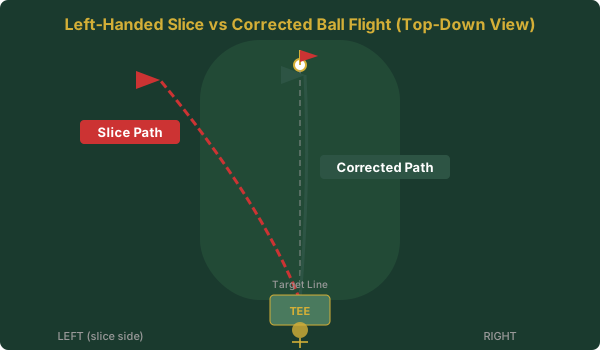
If you're a left-handed golfer watching your ball peel off to the left on every drive, you're dealing with the most common problem in lefty golf: the slice. Unlike right-handed golfers whose slices curve to the right, your slice curves to the left, often sailing into trouble on the opposite side of the fairway from where you expected.
The frustrating part? Almost every slice-fix article, video, and lesson on the internet is written for right-handed players. Trying to mentally reverse those instructions mid-swing is a recipe for confusion and bad habits. This guide is written natively for left-handed golfers. No mirroring, no reversing, no guesswork. Every drill, every tip, every correction is described from your perspective as a lefty.
Whether you're a beginner fighting a banana ball off the tee or an experienced lefty who develops a slice under pressure, this step-by-step guide will help you diagnose the root cause and fix it for good.
Watch: Fixing the Lefty Slice
PGA Professional Dan Baker demonstrates how to correct a left-handed slice:
Understanding the Left-Handed Slice
Before you can fix your slice, you need to understand what causes it. A slice happens when two conditions exist at impact: the clubface is open relative to your swing path, and your swing path travels from outside the target line to inside it (out-to-in for a lefty).
For a left-handed golfer, here's exactly what happens during a slice:
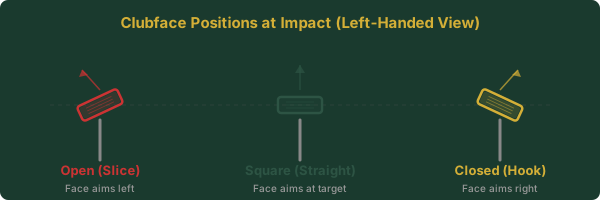
- Your clubface is open at impact: For a lefty, an open clubface points further to the left than your swing direction. This imparts clockwise sidespin on the ball (when viewed from above), which makes the ball curve to the left.
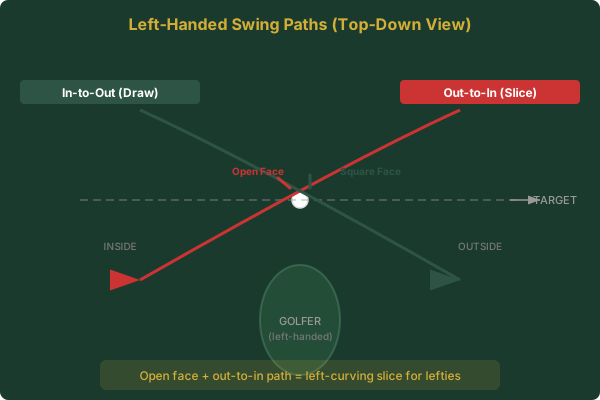
- Your swing path is out-to-in: Instead of swinging along or slightly inside the target line, the club moves from outside the line (further from your body) to inside the line (closer to your body) through impact. This exaggerates the left-curving ball flight.
- The combination creates sidespin: When the face is open to the path, the ball launches slightly right of your swing direction but then curves hard to the left. The bigger the gap between face angle and path, the more severe the slice.
Many lefties develop a slice for reasons unique to their situation. Since most instruction is right-handed, lefties often develop compensations from watching and mimicking right-handed players. Poorly fitted equipment designed for right-handed golfers can also contribute. Understanding these root causes, covered in our swing fundamentals guide, is the first step toward lasting improvement.
Step 1: Check Your Grip
Your grip is the only connection between your body and the club, and for left-handed golfers, a weak grip is the single most common cause of a persistent slice. Getting this right can fix your slice without changing anything else about your swing.
Right Hand (Your Lead Hand)
As a left-handed golfer, your right hand is your lead hand. It sits at the top of the grip and plays the dominant role in controlling the clubface. Here's how to position it correctly:
- Place the grip diagonally across your fingers: The grip should run from the base of your index finger to just below the heel pad. Do not hold the club in your palm. A finger grip allows proper wrist hinge and clubface rotation.
- Check your knuckle count: When you look down at your right hand at address, you should see at least two knuckles, ideally two and a half. If you can only see one knuckle, your grip is too weak and your clubface will be open at impact.
- Position your right thumb: Your right thumb should sit slightly to the right of center on the top of the grip, not directly on top. This encourages the proper wrist angle through impact.
- Apply steady pressure: Maintain firm pressure with the last three fingers of your right hand throughout the entire swing. This prevents the club from twisting open at impact.
Left Hand (Your Trail Hand)
Your left hand is your trail hand. It supports and guides, but it should not overpower your lead hand. Many lefties make the mistake of gripping too tightly with the trail hand, which restricts forearm rotation and keeps the face open.
- Overlap or interlock: Choose whichever grip style (overlap, interlock, or ten-finger) feels most natural, but ensure the left pinky is connected with the right hand to unify both hands.
- Close the gap: Your left thumb should nestle into the lifeline of your right palm. There should be no visible gap between your hands.
- Match the knuckle line: When you look down, your left hand knuckles should be visible too. If the left hand has rotated under the grip, it will fight against clubface closure through impact.
Step 2: Fix Your Alignment
Alignment issues are sneaky because they feel correct even when they're wildly off. Left-handed golfers face a unique alignment challenge: because you stand on the opposite side of the ball from right-handed players, all the visual cues on the course can fool you.
Common Lefty Alignment Mistakes
- Aiming too far right: Many lefties unconsciously aim their body to the right of the target. Your brain knows the ball needs to go toward the target, so it forces an out-to-in swing to compensate, creating the exact path that produces a slice.
- Open shoulders at address: If your left shoulder (trail shoulder) is pulled back at setup, your shoulder line aims right even if your feet are square. This programs an out-to-in swing path.
- Misreading the target line: Tee boxes are not always aligned at the target. As a lefty, you're looking at the tee box from the opposite angle, making it harder to recognize when the tee markers are misleading you.
How to Fix Your Alignment
- Use alignment sticks every practice session: Place one stick along your toe line and another along your target line. Stand behind the ball (from the right side, since you're a lefty) to confirm both are parallel to your target.
- Check all four lines: Your feet, knees, hips, and shoulders should all be parallel to the target line. Use a mirror or ask a playing partner to verify your shoulder alignment specifically.
- Pick an intermediate target: Instead of aiming at a distant target, find a spot on the ground about three feet in front of your ball that sits on your target line. Align your clubface to that spot first, then build your stance around it.
For more alignment strategies tailored to lefties on the course, our course strategy guide covers how to read tee boxes, pick targets, and set up confidently on every hole.
Step 3: Correct Your Swing Path
An out-to-in swing path is the engine that drives a slice. For a left-handed golfer, this means the club approaches the ball from outside your target line (further from your body) and cuts across to the inside (closer to your body) through impact. The result is a glancing blow that imparts left-curving sidespin.
Why Lefties Develop an Out-to-In Path
Several factors unique to left-handed golfers contribute to this destructive path:
- Dominant trail hand taking over: If your left hand (trail hand) is your naturally dominant hand (common for lefties who are actually right-hand dominant in daily life), it tends to pull the club across the ball.
- Over-the-top transition: Starting the downswing with your shoulders instead of your hips throws the club outward, creating the outside-in path.
- Tension from reverse instruction: Years of mentally flipping right-handed tips creates tension and uncertainty, which often manifests as a steep, over-the-top move.
Drills to Fix Your Swing Path
The Headcover Drill: Place a headcover about six inches outside the ball and slightly behind it (on the side away from your body). If your swing path is out-to-in, you'll hit the headcover on the downswing. Practice making swings that miss the headcover on the inside. This trains an in-to-out path that eliminates the slice.
The Right Foot Drop-Back Drill: At address, pull your right foot (lead foot) back about three inches from its normal position. This closes your stance and makes it physically difficult to swing out-to-in. Hit balls from this closed stance until the in-to-out feeling becomes natural, then gradually move your foot back to neutral.
The Trail Elbow Tuck: During your downswing, focus on keeping your left elbow (trail elbow) tucked close to your left hip. If your trail elbow flies away from your body, it pushes the club onto an outside path. A tucked elbow naturally drops the club to the inside, promoting the in-to-out path you need.
Step 4: Square the Clubface
Even with a corrected swing path, an open clubface at impact will still produce a slice. Squaring the clubface requires proper wrist and forearm rotation through the hitting zone. For left-handed golfers, this means your right forearm (lead forearm) must rotate to close the face through impact.
Wrist and Forearm Rotation Drills
The Glove Under the Arm Drill: Tuck a glove or towel under your right armpit (lead arm) and hit half-swing shots. If the glove falls out, your lead arm is separating from your body, which makes it nearly impossible to rotate the face closed in time. Keeping connection ensures your body rotation drives the clubface closure.
The Logo Drill: If you wear a glove on your left hand (trail hand), focus on the logo or brand marking on the back of the glove. Through impact, that logo should rotate to face the ground. If it stays facing the sky or the target, your hands haven't released properly and the face is still open.
The Split-Grip Drill: Grip the club with a two-inch gap between your right hand (lead) and left hand (trail). Make slow-motion swings and feel how your right forearm needs to rotate over your left forearm through the hitting zone. This exaggerated separation makes the rotation obvious and trainable.
Step 5: Ball Position Adjustments
Where you position the ball in your stance has a direct impact on your swing path and clubface angle at impact. Many left-handed golfers unknowingly place the ball too far forward in their stance (too close to the right foot), which promotes the out-to-in path that causes a slice.
Optimal Ball Positions for Lefties Fighting a Slice
- Driver: Position the ball just inside your right heel (lead heel). Many lefties play it too far forward, off the right toe or even ahead of it. This forces you to reach for the ball, opening the shoulders and promoting a slice. Moving it back slightly allows you to make contact while the club is still traveling on an in-to-out path.
- Fairway Woods and Hybrids: Play the ball about one ball-width inside your right heel. This is slightly further back than where many lefties instinctively place it, but it encourages better contact and a more neutral path.
- Mid Irons (5-7): Position the ball one ball-width right of center in your stance. This ensures you're making contact on a slightly descending blow with a square face.
- Short Irons and Wedges: Center of your stance or slightly right of center. These clubs require a steeper angle of attack, and centering the ball helps you compress it properly.
Having the right equipment matters too. Clubs that are properly fitted for your left-handed swing can reduce your tendency to slice. Our club fitting guide explains what specifications lefties should look for when selecting and fitting clubs.
How Ball Position Affects Your Slice
When the ball is too far forward (toward your right foot) in your stance, three things happen that promote a slice:
- Your shoulders open: Reaching for a forward ball position pulls your left shoulder back, opening your shoulder line to the right. This programs an out-to-in swing path.
- The club is already traveling outward: At a forward ball position, the club has already passed the low point of the arc and is traveling back to the inside. Contact here means the club is cutting across the ball.
- The face has time to open: The longer the club travels past the bottom of the arc, the more time the face has to rotate open. Moving the ball back puts impact closer to the low point, where the face is squarer.
Step 6: Practice Drills for the Range
Knowing what to fix is one thing. Training your body to execute the corrections is another. These four drills are designed specifically for left-handed golfers working to eliminate a slice. Spend at least 20 minutes on these drills before hitting full shots during your practice sessions.
Drill 1: The 9-to-3 Swing
Start with half swings where your hands move from roughly the 9 o'clock position in the backswing to the 3 o'clock position in the follow-through. Use a 7-iron and focus on three things: keeping the trail elbow (left elbow) tucked, feeling the right forearm rotate through impact, and finishing with the toe of the club pointing upward at the 3 o'clock position.
Hit 20 balls with this drill. You should notice the ball starting slightly right of your target and either flying straight or gently curving to the right (a draw for a lefty). If the ball is still curving left, your face is still open. Strengthen your grip and try again.
Drill 2: The Feet-Together Drill
Place your feet together with the ball positioned in the center of your narrow stance. Hit shots with a smooth, three-quarter swing. This drill eliminates sway and forces your body to rotate rather than slide. It also makes it very difficult to swing out-to-in because you have no room to shift laterally.
Start with a pitching wedge and work up to a 7-iron. Focus on balance and solid contact. After 15-20 shots, gradually widen your stance back to normal while maintaining the rotational feel.
Drill 3: The Inside Path Gate
Set up two tees about four inches apart, creating a gate just outside and behind the ball. The gate should be angled so that it is slightly inside the target line. Practice swinging the club through the gate without disturbing either tee. If you swing out-to-in, the clubhead will knock over the outside tee. This provides immediate visual feedback on your path and trains the in-to-out motion you need.
Start slowly with chip-length swings and gradually increase your swing length as you consistently pass through the gate cleanly.
Drill 4: The Right-Hand-Only Drill
Using a short iron, grip the club with only your right hand (lead hand). Make smooth, controlled half-swings. This drill accomplishes two things: it strengthens your lead hand control, and it trains your right arm to rotate properly through impact. Without the trail hand interfering, you'll feel exactly how the lead arm needs to work to square the face.
Hit 10-15 balls with your lead hand only, then immediately hit 10 balls with both hands. The sensation of lead-hand control should carry over into your full swing.
Common Mistakes Lefties Make When Fixing a Slice
Even with the right drills and knowledge, left-handed golfers often fall into traps that prevent them from eliminating the slice. Be aware of these common pitfalls:
- Aiming further right to compensate: If your ball curves left, aiming right feels logical. But aiming right forces your body to swing even more out-to-in to get the ball back to the target, making the slice worse. Fix the root cause instead of compensating for the symptom.
- Swinging harder to overpower the curve: A harder swing usually means more tension, especially in the trail hand. More tension restricts forearm rotation, keeps the face open longer, and produces an even bigger slice. Swing easier, not harder, while working on the fix.
- Only fixing the grip OR the path: The slice is caused by the relationship between clubface and path. Fixing one without the other can turn a slice into a pull or a pull-hook. Work on both simultaneously for balanced improvement.
- Mentally mirroring right-handed tips: This is the trap lefties fall into most often. Reading a right-handed tip and trying to reverse it mid-practice creates confusion and inconsistent results. Seek out lefty-specific instruction or translate the tip completely before hitting the range.
- Neglecting short game practice: It's tempting to spend every session working on your full swing slice. But short game practice builds face awareness and hand control that transfers directly to your full swing. Mix in chipping and pitching drills between your slice-fix work.
- Changing too many things at once: Work through the steps in order. Start with grip, move to alignment, then path, then face, then ball position. Trying to overhaul everything at once overwhelms your motor system and leads to regression.
When to See a Pro
If you've worked through all six steps consistently for two to three weeks and your slice persists, it may be time to seek professional instruction. But finding a pro who truly understands the left-handed swing can be a challenge.
Tips for Finding Left-Handed Instruction
- Ask if they teach lefties regularly: Many instructors claim to teach all players but rarely work with left-handed golfers. Ask specifically how many lefty students they currently have.
- Look for lefty pros: A left-handed teaching professional will understand your perspective intuitively. They won't need to mentally mirror anything, and their demonstrations will be directly applicable to your swing.
- Use video analysis: If you can't find a lefty-specific instructor locally, consider online instruction. Record your swing from two angles (down-the-line and face-on) and submit it for review. Several online coaches specialize in left-handed players.
- Request a trial lesson: Before committing to a lesson package, book a single session focused on your slice. Pay attention to whether the instructor gives you lefty-native cues or simply reverses right-handed language. The difference matters.
- Check their technology: Launch monitors and swing analysis tools work identically for lefties and righties, but not all instructors know how to set them up for left-handed players. Confirm they can configure their equipment for your swing.
Fix Your Slice and Play Your Best Lefty Golf
The slice is not a permanent sentence. It's a mechanical issue with a mechanical solution, and now you have six concrete steps to address every aspect of it. Start with your grip, work through alignment and path, dial in your clubface and ball position, and reinforce everything with focused range drills.
Remember: you're a left-handed golfer, and that's an advantage when you understand how to use it. A controlled draw (right-curving ball flight for a lefty) is one of the most powerful shots in golf, and it's the natural progression once you eliminate the slice. Courses that punish right-handed slicers become friendlier to a lefty who can work the ball the other direction.
If you haven't already, make sure to read our 5 Swing Fundamentals Every Lefty Must Master for the complete foundation, and our Course Strategy for Left-Handed Players to put your improved swing to work on the course.