Left-Handed Golf Statistics: What the Data Says in 2026
Left-handed golfers have always been a minority in the sport, but just how small is that minority — and what does the data actually tell us? Whether you're a lefty looking for validation, a coach trying to understand the landscape, or an equipment manufacturer sizing a market, the numbers paint a fascinating picture. This page compiles the most current and comprehensive left-handed golf statistics available, covering player demographics, professional tour performance, equipment availability, and global trends.
We built this as a reference — a single page you can bookmark, cite, and share. If you're writing about left-handed golf or discussing it with your foursome, the data is here.
How Many Golfers Are Left-Handed?
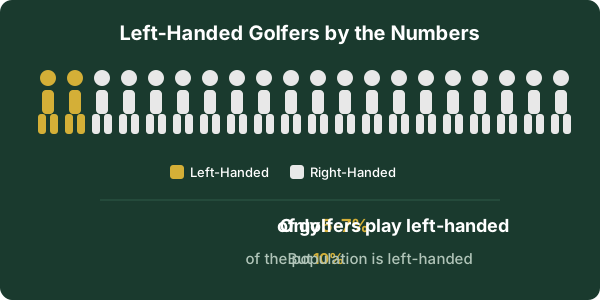
The short answer: fewer than you'd expect. Approximately 5-7% of all golfers worldwide play left-handed. That's a significant underrepresentation when you consider that roughly 10% of the general population is left-handed. The gap suggests that many naturally left-handed people either learn to play right-handed — often due to limited equipment access or right-handed instruction — or avoid the sport altogether.
In raw numbers, the United States has an estimated 25-27 million active golfers. Applying the 5-7% figure puts the number of left-handed golfers in the US at roughly 1.5 to 2 million players. That's not a niche — it's a meaningful segment of the market, larger than the entire population of many mid-sized cities.
Left-Handed Golfer Demographics at a Glance
- 5-7% of all golfers play left-handed
- 10% of the general population is left-handed
- 1.5-2 million estimated lefty golfers in the US
- 15-20% of Canadian golfers play left-handed
- 30-40% gap — lefties are underrepresented in golf vs. the general population
Canada is a notable outlier. An estimated 15-20% of Canadian golfers play left-handed, roughly triple the global average. The leading theory is the hockey crossover effect: Canada's dominant sport is hockey, where a large percentage of players shoot left-handed. The motor patterns and hand positioning from hockey translate naturally to a left-handed golf swing, making Canadians far more likely to pick up a club on the left side. Mike Weir, Canada's most famous golfer, is a prime example of this crossover — and his success inspired an entire generation of Canadian lefties to stay left-handed rather than switch.
The underrepresentation of lefties in golf matters because it creates a compounding cycle. Fewer left-handed golfers means less demand for left-handed equipment, which means less shelf space, which makes it harder for new lefties to find clubs, which discourages them from starting. Breaking that cycle is one of the reasons we built our guide on choosing which hand to play — so new golfers make that decision based on their natural ability, not equipment availability.
Left-Handed Golfers on the PGA Tour
Professional golf skews even further right-handed than recreational golf. Historically, only about 3-5% of PGA Tour players at any given time are left-handed. In a typical field of 156 players, that translates to roughly 5 to 8 lefties teeing it up. Despite that small representation, left-handed golfers have produced some of the most memorable careers and moments in tour history.
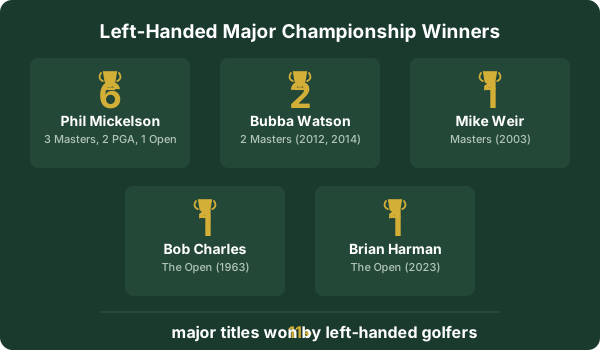
Phil Mickelson stands as the most accomplished left-handed golfer of all time by virtually every measure. His resume includes 45 PGA Tour victories, 6 major championships (3 Masters, 2 PGA Championships, 1 Open Championship), and career earnings exceeding $95 million on the PGA Tour alone. Mickelson's longevity is remarkable — he won his first PGA Tour event in 1991 and his most recent major in 2021, spanning three decades of competitive golf. For the full breakdown, see our profile of famous left-handed golfers.
Bubba Watson brought a completely different style to left-handed golf. A self-taught player with no formal lessons, Watson used raw power and shot-shaping creativity to win 12 PGA Tour events, including 2 Masters titles (2012 and 2014). His ability to curve the ball in both directions off the tee made him one of the most entertaining players to watch — and proof that lefties could dominate at Augusta National.
Mike Weir holds a special place in left-handed golf history. His 8 PGA Tour wins include the 2003 Masters, making him the first left-handed golfer to win a green jacket and only the second lefty to win any major in the modern era. Weir's victory was a watershed moment — it proved definitively that left-handed players could compete and win at golf's highest level.
The historical foundation was laid by Bob Charles of New Zealand, who became the first left-handed golfer to win a major championship at the 1963 Open Championship. Charles was a putting virtuoso whose smooth stroke set the standard for left-handed players for decades. More recently, Brian Harman added to the lefty legacy with his dominant victory at the 2023 Open Championship at Royal Liverpool, winning by six strokes — the largest margin at The Open since Tiger Woods in 2000.
By the Numbers: Left-Handed PGA Tour Wins
- Phil Mickelson: 45 PGA Tour wins, 6 majors, $95M+ career earnings
- Bubba Watson: 12 PGA Tour wins, 2 Masters titles
- Mike Weir: 8 PGA Tour wins, 1 Masters (2003)
- Brian Harman: 2023 Open Championship winner
- Bob Charles: First lefty major winner (1963 Open Championship)
- ~3-5% of PGA Tour fields are left-handed in any given season
Equipment Availability for Left-Handed Golfers
Equipment availability has long been the most practical frustration for left-handed golfers, and the data explains why. While the situation has improved dramatically over the past decade, meaningful gaps remain.
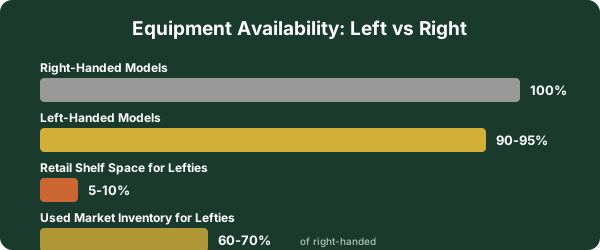
On the manufacturing side, the news is mostly positive. Major OEMs — TaylorMade, Callaway, Titleist, Cobra, Ping, Cleveland — now offer approximately 90-95% of their product lines in left-handed versions. Flagship drivers, iron sets, and putters are almost always available for lefties. The gaps tend to appear in specialty items: certain wedge grinds, limited-edition finishes, and some tour-only equipment may be right-handed exclusive. For a detailed breakdown of what's available, check our best left-handed golf clubs guide.
Retail is where the disparity becomes more visible. In brick-and-mortar golf stores, left-handed clubs typically occupy just 5-10% of floor space. That mirrors the market share but creates a frustrating shopping experience — you can't demo what isn't on the rack. Many lefties report driving to multiple stores to find a specific club to try before buying, or resorting to ordering online without hitting the club first.
The pre-owned market amplifies the problem further. Used and pre-owned left-handed club inventory is estimated to be 30-40% smaller than the equivalent right-handed inventory on platforms like GlobalGolf, 2nd Swing, and Callaway Pre-Owned. Because fewer lefty clubs are sold new, fewer enter the used market — and they tend to sell faster when they do appear, leaving thinner selection at any given time.
Custom fitting presents another gap. Left-handed demo clubs and fitting shafts are less commonly stocked at fitting centers, which means custom fitting wait times can run 2-4 weeks longer for left-handed builds compared to right-handed orders. Some fitters may need to special-order demo heads in left-handed orientation before the fitting can even take place. Our club fitting guide covers how to navigate this process efficiently.
The silver lining is online retail. Major e-commerce golf retailers have largely closed the availability gap for new equipment. Online, you can find and order nearly any current-model left-handed club with the same delivery timeline as right-handed. The shift to online purchasing has been disproportionately beneficial for left-handed golfers.
The Left-Handed Advantage (and Disadvantage)
Does playing left-handed give you any inherent edge on the golf course? The answer is nuanced — there are potential advantages and clear disadvantages depending on how you measure.
On the advantage side, research in sports science suggests that left-handed athletes may have a measurable edge in sports requiring hand-eye coordination and spatial awareness. The theory centers on brain lateralization — left-handers tend to have greater right-hemisphere involvement in motor tasks, which may improve visual-spatial processing. Whether this translates to a statistically significant advantage in golf specifically is debated, but the concentration of elite lefty talent (Mickelson, Watson, Weir) relative to the tiny lefty player pool is notable.
The disadvantages are more concrete. Golf course design historically favors right-handed players. The majority of dogleg holes bend to the left (dogleg-left), which suits a right-handed player's natural draw or fade pattern. Left-handed players facing a dogleg-left must either hit against their natural shot shape or play a more conservative line. While modern course design has become more balanced, the legacy layout of most courses tilts the playing field slightly toward righties.
The instruction gap is arguably the biggest disadvantage. An estimated 95% or more of golf instruction content — books, videos, articles, and in-person lessons — is designed and demonstrated for right-handed players. Left-handed golfers must mentally mirror every piece of instruction they consume, which introduces an extra cognitive step that right-handed players never deal with. This is particularly challenging for beginners who are still building foundational mechanics.
One of the most fascinating data points in left-handed golf: Phil Mickelson is naturally right-handed. He writes, eats, and throws right-handed in daily life. He plays golf left-handed because he learned by mirroring his father's right-handed swing as a child, standing face-to-face. This fact complicates any simple narrative about left-handedness conferring an advantage — the greatest left-handed golfer of all time isn't even left-handed.
Left-Handed Golf Around the World
Left-handed golf participation varies significantly by country, driven by cultural factors, dominant sports, and equipment access.
The countries with the highest percentage of left-handed golfers are Canada, Australia, and the United Kingdom. Canada leads at 15-20%, as discussed above. Australia and the UK both sit in the 8-12% range, above the global average, likely influenced by cricket — a sport where batting left-handed is common and carries no stigma.
Japan has among the lowest rates of left-handed golfers globally, estimated at just 1-2%. This reflects broader cultural patterns in Japan where left-handedness has traditionally been discouraged, and educational systems have historically encouraged children to use their right hand for writing and daily tasks. The result is that very few Japanese golfers develop left-handed swings, despite Japan being one of the world's largest golf markets.
The growth data tells an interesting story. In several markets — including the US, Canada, and parts of Europe — left-handed golf participation is growing faster in percentage terms than right-handed participation. This is partly driven by better equipment availability, increased online instruction tailored to lefties, and a cultural shift toward letting children play with whichever hand feels natural rather than forcing right-handed play. The stigma around left-handedness in golf is fading, and the numbers reflect that generational change.
Key Takeaways
Here are the most quotable left-handed golf statistics from this article — the numbers worth remembering and citing.
- 5-7% of all golfers play left-handed, despite 10% of the population being left-handed
- There are an estimated 1.5-2 million left-handed golfers in the United States
- Canada has the highest lefty golfer rate at 15-20%, largely due to hockey crossover
- Only 3-5% of PGA Tour players are left-handed in any given season
- Phil Mickelson holds 45 PGA Tour wins and 6 major championships — the most by any left-handed golfer
- Major equipment manufacturers offer 90-95% of their lines in left-handed versions
- Left-handed clubs get just 5-10% of retail shelf space in physical stores
- The pre-owned market has 30-40% less left-handed inventory than right-handed
- An estimated 95%+ of golf instruction content is right-handed oriented
- Japan has the lowest lefty golfer rate at 1-2%; Canada has the highest at 15-20%
- Left-handed golf participation is growing faster than right-handed in several major markets
Have a statistic we should add? Reach out — we want this to be the most complete lefty golf data page on the internet.